DIY Escape Room at Home, from Story to Finale
Build a DIY escape room at home from a short premise, a backward clue chain, paper checks, a quiet test, and a finale proved with a sealed envelope.
To make a DIY escape room at home, write a premise you can read in two sentences, decide the finale first, build about five links that mix puzzles and tasks, prove each answer on paper, and test the chain on someone who is new to the puzzles. Puzzling Pursuits says paper and envelopes are enough to start, and a sealed envelope can check an answer in place of a padlock. Escape Room Geeks keeps the opening story around 200 words, because anything that takes more than 2 minutes to read is a long story.
A printed game is a later shortcut. The build below stands on its own.
A premise short enough to read aloud
The theme tells players which objects deserve attention. Write two sentences you will read at the start. If the premise will not fit in two sentences, it is too tangled for the first minutes of play (Puzzling Pursuits).
A home game can be a hunt for a prize rather than a locked room. A birthday present can be hidden, and the clues lead to it. That premise works because the players already want the prize. Other premises that earn a deadline: shut in a Victorian house until midnight, an inheritance hidden behind challenges, a laboratory the owner is about to re-enter, or a broken time machine the team must repair (Puzzling Pursuits).
Tie the story to something the players care about. One builder hid trip tickets and made the story a hunt for treasure in a castle, so the last find was the real gift (Escape Room Geeks). Add a little mystery, then a deadline, so the clock is part of the story and not a random buzzer.
The ending, then the chain backward
Write the last answer before you make the first puzzle. Sketch what opens what, in what order, and what the final answer is. If you invent puzzles first and try to connect them later, you get three good puzzles and a gap on the night (Puzzling Pursuits).
Aim for about five links on a first game. A link is anything that must be solved or done before the next thing opens. Not every link should be a puzzle. Alternate puzzles and tasks. A task is something players can see how to do: assemble a torn note, follow a short maze, or use a cipher key that you left in plain sight. A puzzle asks them to discover the method first, such as a reversed message next to a mirror (Puzzling Pursuits).
Choose the shape on purpose. A linear chain, one thing at a time, is easier to build and easier to hint. The cost is that one person solves while the others watch. If you are running this for more than four people, open two strands in parallel and have them meet at the finale (Puzzling Pursuits). Draw that shape on one sheet before you hide anything. If a later puzzle can be opened early and skip the earlier ones, the chart is wrong. Fix the chart, then hide the props.
Paper checks instead of a hardware list
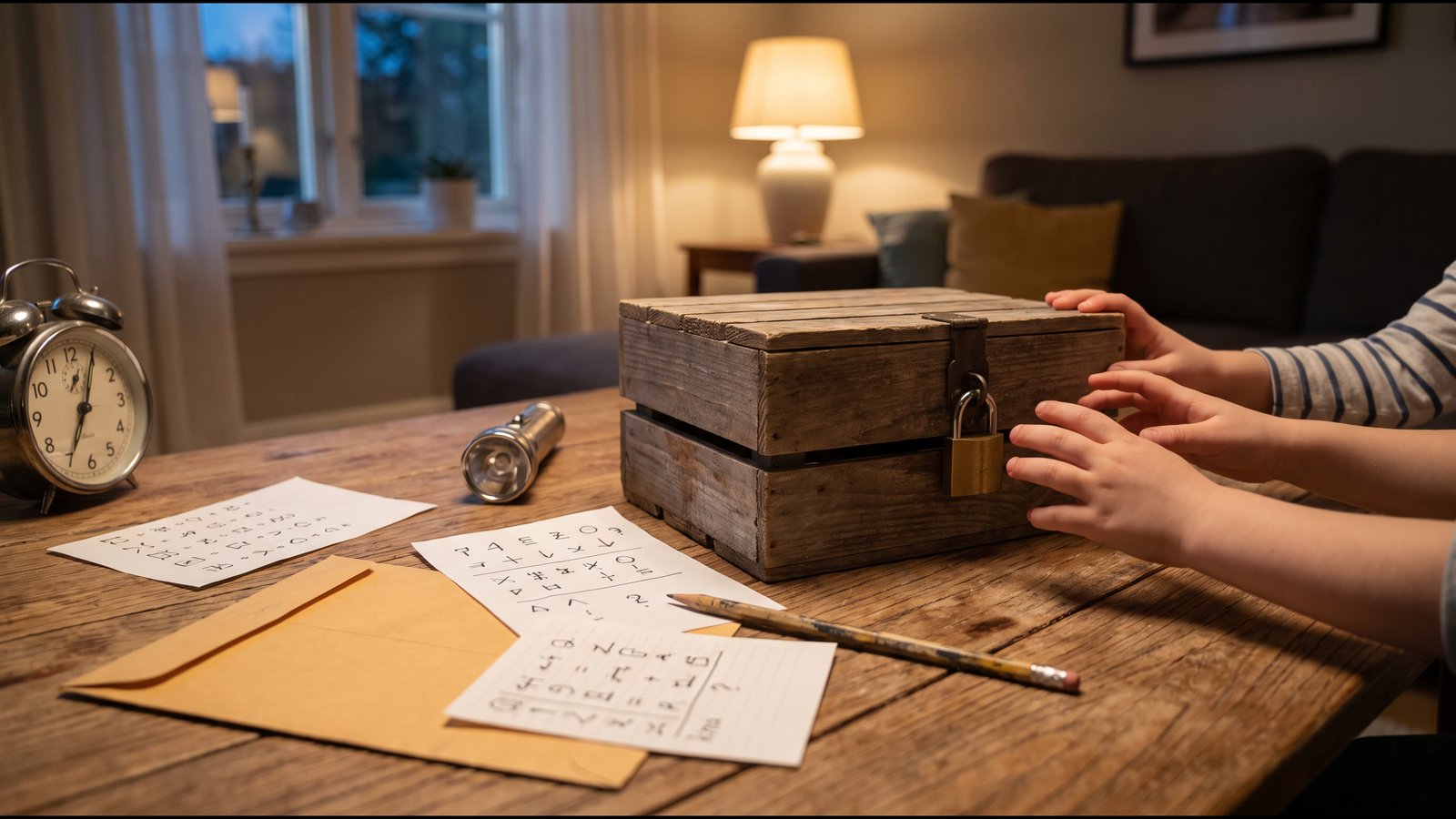
Locks are optional. Puzzling Pursuits says you can use locks, or have the host check each answer and hand over the next envelope. Keep each next envelope with the host. Players say the answer they want checked. Hand that envelope over only after the answer is right. On a miss, the envelope stays closed with the host, so the answer and the next clue stay unread.
Puzzles that need almost nothing from a kitchen drawer:
- Pigpen cipher: give the alphabet key beside a short encoded message.
- Torn strip: write a number across paper, tear it, and let matching edges restore it.
- Book cipher: three numbers mean a page, a line, and a word. Mark the book and use the same edition when you test.
- Message jigsaw: write the next instruction on a sheet and cut it up.
- Mirror writing: leave a mirror near a reversed message, and check the card in that mirror yourself.
- White crayon and watercolor: write in white crayon on white paper and leave paints nearby.
- First-letter code: a normal-looking paragraph hides the message in the first letter of each sentence (Lock Paper Escape).
A word lock, a key lock, or a directional lock can sit on a box if you already own one. Players solve a puzzle to learn the combination, then open the box for the next clue (Lock Paper Escape). Buy locks only when the story needs a click. The paper checks above are enough for a first night.
The Lock Paper Escape idea list has no storyline and no test before guests arrive. Take the puzzle mechanics from it. Build the chain and the test from the steps on this page.
A quiet test and a clean room
You already know every answer, so the path looks obvious to you. Hand the game to one person who is new to the puzzles and stay quiet. Watch where they hesitate, what they pick up first, and which wrong theory they commit to. Time the test, and also watch for progress. Steady decoding can be a long puzzle they are enjoying. The same guess repeated means the clue needs clearer feedback or an earlier hint (Puzzling Pursuits).
One tester is a useful start. Leave time to change the clues they stalled on, then check the revised clues before you set the room. If the tester lives too far to visit, send photos of the paper puzzles and talk through the physical steps separately.
Then clear the space. Objects that are not part of the game should leave the room. Escape Room Geeks uses the picture of 20 books on a shelf, with those books outside the game, to show how a search turns dull. Give a clue toward each hiding place, and tell players which areas are in play.
Split setup into regular tasks and last-minute tasks. Locking a box and hiding a key can happen hours ahead. A phone battery or a light code may have to wait until minutes before start (Escape Room Geeks). Write both lists. Prepare short hints, riddle-length, for the steps that stalled in the test. When someone asks, give the short hint you wrote. A lecture hands them the answer and ends the game.
What the last answer unlocks
The final answer should lead to a clear finish: opening the prize box, or reading the last part of the story (Puzzling Pursuits). Say that finish out loud in the premise, so players know what winning looks like. After the last check, read the ending, hand over the prize, and stop. Extra puzzles after the prize feel like homework.
For a larger adult group, run two strands so people have separate clues to compare, and make the final lock need both halves. Keep misleading clues few. Players should be able to say why they ruled one out (Puzzling Pursuits). For younger players, shorten the chain and match the reading level. Pictures and a code key help. Have an adult who knows the answers nearby, and be ready to shorten a step if interest drops.
If the night is New Year's Eve, the finale can be the prize they open before the countdown, and the rest of the evening can move to New Year's Eve activities at home or family New Year's Eve games. A grown-up game list, sorted by how many people are in the room, is in New Year Eve games adults can play.
One outside tester will miss some of what a full group does. Leave an evening between the test and the party so you can rewrite the clue that stalled.
An optional printed game if the build can wait
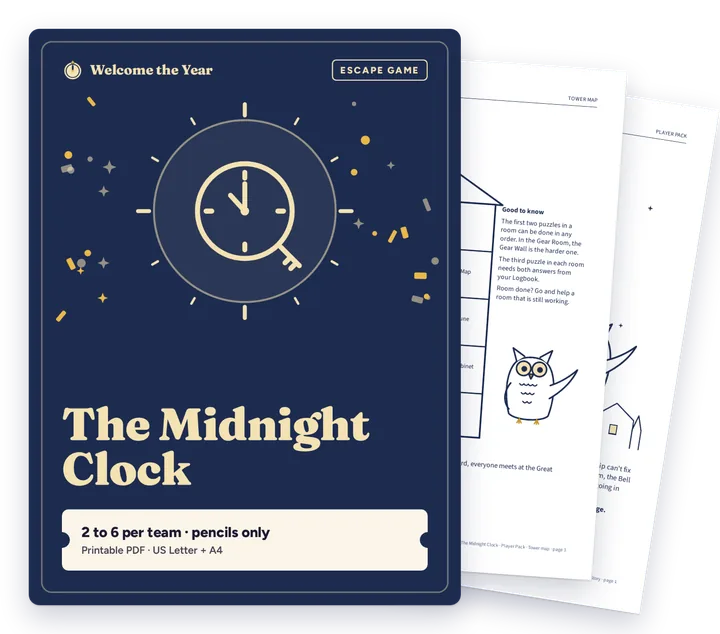
The route above is the build. A purchase is a shortcut, not a requirement. If you want the puzzles already written, the Midnight Clock escape game is a printable New Year's Eve escape game for a family team to solve with pencils before the countdown. It includes a player pack with a story, how to play, a tower map, a logbook, ten linked puzzles, the Great Clockwork finale, hint cards and a host guide with the full answer key. It is written for 2 to 6 per team, with about 45 to 75 minutes of play and about 10 minutes of setup. It needs pencils only: nothing to cut or assemble. It sets age 8 to 12 with adults, and difficulty, as design targets, not tested with children. It is sold as printable PDFs for $11.00. Use it when you want a finished paper game for a New Year's Eve table. Use the steps above when you want to build the story yourself.
Questions and answers
What to do instead of an escape room?
Play a table puzzle, host a mystery party, or use a printed game you solve with pencils. The build below is the escape-room route. A printed game is only a shortcut.
What are some fun puzzles I can make for an at-home escape room?
A pigpen cipher with its key, a torn number strip, a book cipher, a message jigsaw, mirror writing, white crayon under watercolor, and a first-letter code.
How to make a homemade escape room?
Write a short premise, decide the finale, build a short chain of puzzles and tasks, check answers on paper, test with someone new to the puzzles, then set the room.
Sources
- DIY Escape Room: 7 Steps I Used to Build Mine, Escape Room Geeks (2026)
- 13 Easy Escape Room Ideas You Can Use, Lock Paper Escape (2026)
- DIY escape room ideas for adults (and kids): 12 puzzles and a four-step plan, Puzzling Pursuits (2021)