New year trivia questions with answers for a mixed-age table
Sourced new year trivia with answers for kids and adults, from the calendar, the date line, and the sunrise, plus how to host a mixed-age table.

New year trivia that holds up at the table starts with the answers hosts get asked first, then an easier round and a harder round. The two rounds are separate question sets. Read either one on its own.
- Eve means the day or period before an important event, the sense Cambridge Dictionary gives the word.
- The civil calendar in use today is the Gregorian calendar, introduced in 1582 by Pope Gregory XIII, on the U.S. Naval Observatory Introduction to Calendars.
- On Romper's trivia list, the date-line question asks where New Year's is celebrated first each year, and the answer is the Kiritimati Atoll in Kiribati. The BBC's 2026 account says Kiritimati (GMT+14), also known as Christmas Island, was the first place in the world to celebrate the new year, and that it hit midnight when it was still 10:00 GMT. That page calls Kiritimati an atoll of the Pacific nation of Kiribati.
- Snopes gives the bulk of the credit for standardizing New Year's Day to Julius Caesar. His reform plan called for a calendar beginning with the first of January, the Julian calendar was the first to codify Jan. 1 as that start, and historians generally agree Roman institutions had already switched to that date long before Caesar rose to power. The Gregorian calendar later reaffirmed Jan. 1 as the official beginning of the year, on that same page.
- The first populated land where the sun rises on January 1 is Pitt Island in the Chatham Islands, a dependency of New Zealand, on the Observatory First Sunrise of the New Year page. That sunrise fact is a different question from which place celebrates first. It is not a correction of the Kiritimati answer.
- In 1995, Kiribati moved the International Date Line so the entire country is on the western side of it, which that same sunrise page records.
Answers to read first
Host from this page. Read one round at a time, and keep the source sentence with the answer. The questions below are written for this guide. They are calendar, date-line, and sunrise facts, not a copy of a party-ball quiz. The easier questions and the harder questions are separate.
Easier round
Why is the night before January 1 called Eve? Eve means the day or period before an important event, on the Cambridge Dictionary page, and that page uses New Year's Eve as the example.
What did eve mean in older English? An older sense of eve, also on the Cambridge Dictionary page, is the evening.
Which calendar is the civil calendar in use today? The Gregorian calendar, introduced in 1582 by Pope Gregory XIII, has become the internationally accepted civil calendar, on the Introduction to Calendars page.
Who introduced the calendar that adds an extra day every four years? The Julian calendar was introduced by Julius Caesar in 45 BC, and it introduced a simple leap year rule of an extra day every four years, on that Introduction to Calendars page.
Where is the sun up across most of a continent on January 1? On any January 1, the sun is continuously above the horizon across most of Antarctica, so the First Sunrise of the New Year page says the year is already daylight there.
Is there one spot that owns the first sunrise at midnight UTC? At 0h UTC on January 1 there is no unique first sunrise location, because the sun rises along a line, on that First Sunrise of the New Year page.
Which populated land sees the January 1 sunrise first? The first populated land where the sun rises on January 1 is Kahuitara Point on Pitt Island in the Chatham Islands, a dependency of New Zealand, on the First Sunrise of the New Year page.
What did Kiribati change in 1995? In 1995, Kiribati moved the International Date Line so that the entire country is on the western side of it, on the First Sunrise of the New Year page.
What happened to sailors who went all the way around the world? Travelers going westward discovered that one day more than they thought had passed, as happened to Magellan's crew, on the International Date Line page.
Why does a calendar need leap days at all? The year is not an integral count of days, which the Introduction to Calendars page gives as the reason calendars are complicated.
Harder round
What is the Gregorian leap-year rule? Years evenly divisible by 4 are leap years, with the exception of centurial years that are not evenly divisible by 400, on the Observatory Leap Years page.
How long is the cycle of the seasons? The tropical year is approximately 365.2422 days, and a calendar stuck at 365 days would fall short of it, on the Leap Years page.
Where is it most convenient to draw the date line? The International Date Line can be anywhere on the globe, but it is most convenient to be 180° away from the defining meridian that goes through Greenwich, England, on the International Date Line page.
Which side of the line were the Philippines on, and until when? Until 1845, the Philippines were on the eastern side of the International Date Line, the same side as the United States, on that International Date Line page.
What did Kiribati claim about Caroline Island? Kiribati had put forth the claim that Caroline Island would be the first point of land where the sun would rise. The First Sunrise of the New Year page places that sunrise after the first place in the Antarctic.
How do Islamic months sit against the seasons? The cycle of twelve Islamic months regresses through the seasons over a period of about 33 years, on the Introduction to Calendars page.
Which calendar does the State of Israel use officially, and how old is its calculated form? The Jewish calendar that dates from the time of Hillel II (359 CE) is the official calendar of the State of Israel, on the Introduction to Calendars page.
Why was the Gregorian calendar introduced? The Gregorian calendar resulted from a perceived need to reform the calculation method for the dates of Easter, and it was introduced in 1582 by Pope Gregory XIII, on the Introduction to Calendars page.
What is still true of the Julian calendar? The Julian calendar and variations of it are still in use by some groups to set the dates for liturgical events, on the Introduction to Calendars page.
What should a host say if a guest answers Kiribati? Ask which question was read. If it is which place celebrates first, Romper names the Kiritimati Atoll in Kiribati, and the BBC's 2026 account says that atoll hit midnight at 10:00 GMT. If it is the first populated sunrise, the First Sunrise of the New Year page names Pitt Island. Use the celebration pages for the celebration question, and the sunrise page for the sunrise question.
Two independent rounds
Sit mixed ages in teams. Read the easier round, pause for written answers, and stop there if the younger players are done. Read the harder round as its own set when the table wants a second pass. Score a point for a matching idea, and read the source sentence so a dispute ends on the page rather than on memory.
A full evening of paper games can continue with family New Year's Eve games or the wider New Year's Eve games list. A quieter house plan is in New Year's Eve activities at home.
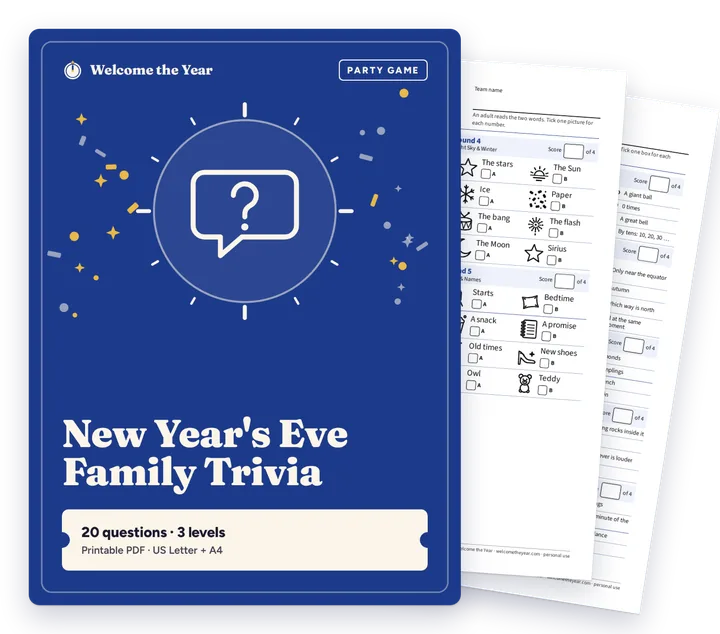
When you want the sheets already ruled for three ages, the New Year's Eve Family Trivia printable is a New Year's Eve quiz the whole family plays at the table: the host reads each question once, and each team answers it on the sheet for its level. It includes a Little player sheet of 20 questions, each with 2 picture choices, a Big Kids player sheet with 3 choices, and a Teens & Adults player sheet with 4 choices, plus a team score sheet. It is print-only: answers are ticked by hand. The download is $3.00.
Where this quiz stops
These answers stay with the calendar and sunrise pages named above. Songs, foods, and local midnight customs sit outside those pages, so leave them for a tradition round you can check on a page you have opened.
Questions and answers
Which country celebrates new year first?
Romper's date-line question names the Kiritimati Atoll in Kiribati as where New Year's is celebrated first each year. The BBC's 2026 account says Kiritimati (GMT+14) was the first place to celebrate and hit midnight at 10:00 GMT. Pitt Island's first populated sunrise is a different question.
What are some facts about new years?
Eve means the day or period before an important event. The civil calendar in use today is the Gregorian calendar, introduced in 1582. The date line is most convenient 180 degrees from Greenwich.
Why is New Year's Eve called Eve?
Eve means the day or period before an important event, so New Year's Eve is the day before the civil new year.
Who decided January 1st is the new year?
Snopes gives the bulk of the credit for standardizing New Year's Day to Julius Caesar. His reform called for a calendar beginning with the first of January, and the Julian calendar was the first to codify Jan. 1 as that start, though Roman institutions had already been observing it. The Gregorian calendar later reaffirmed Jan. 1 as the official beginning of the year.
Why do they celebrate new years?
People mark the turn of the civil year. The calendar page explains that the year does not comprise an integral number of days, which is why a calendar needs rules.
What are some fun facts about New Year's?
Most of Antarctica is in daylight on January 1. The first populated sunrise land is Pitt Island. Kiribati moved the date line in 1995.
What are some interesting trivia facts about New Year's Eve?
Magellan's crew gained a day by sailing west. Until 1845 the Philippines sat on the eastern side of the date line, the same side as the United States.
What are some interesting and unusual New Year's trivia and fun facts?
At midnight UTC on January 1 there is no unique first sunrise. Kiribati claimed Caroline Island would be first land, and the sunrise page places that sunrise after Antarctica.
What are some fun facts about New Year's Eve?
An older sense of eve is the evening. A tropical year is about 365.2422 days, so leap days keep the calendar near the seasons.
Why is there a New Year's Eve?
Eve is the day or period before an important event, and January 1 is the start of the civil year on the Gregorian calendar.
When was the very first New Year's Eve?
The opened calendar page dates the Julian calendar to 45 BC and the Gregorian calendar to 1582. It leaves the first party undated.
What is a interesting fact about New Year's Eve?
The Jewish calendar used as the official calendar of the State of Israel dates from the time of Hillel II in 359 CE, and Islamic months shift through the seasons over about 33 years.
Sources
- EVE | English meaning, Cambridge Dictionary
- Introduction to Calendars, U.S. Naval Observatory
- Leap Years, U.S. Naval Observatory
- International Date Line, U.S. Naval Observatory
- First Sunrise of the New Year, U.S. Naval Observatory
- New Year's Trivia Questions & Answers, Romper
- New year welcomed with celebrations across the globe as world enters 2026, BBC News (2026)
- Julius Caesar: He Came, He Saw, He Conquered the Calendar and Gave Us New Year's Day, Snopes (2024)