Goal bingo: how to fill a card and play it through the year
How to build your own goal bingo card at home with words or pictures, mix big goals and small wins, and cross the squares off throughout the year.
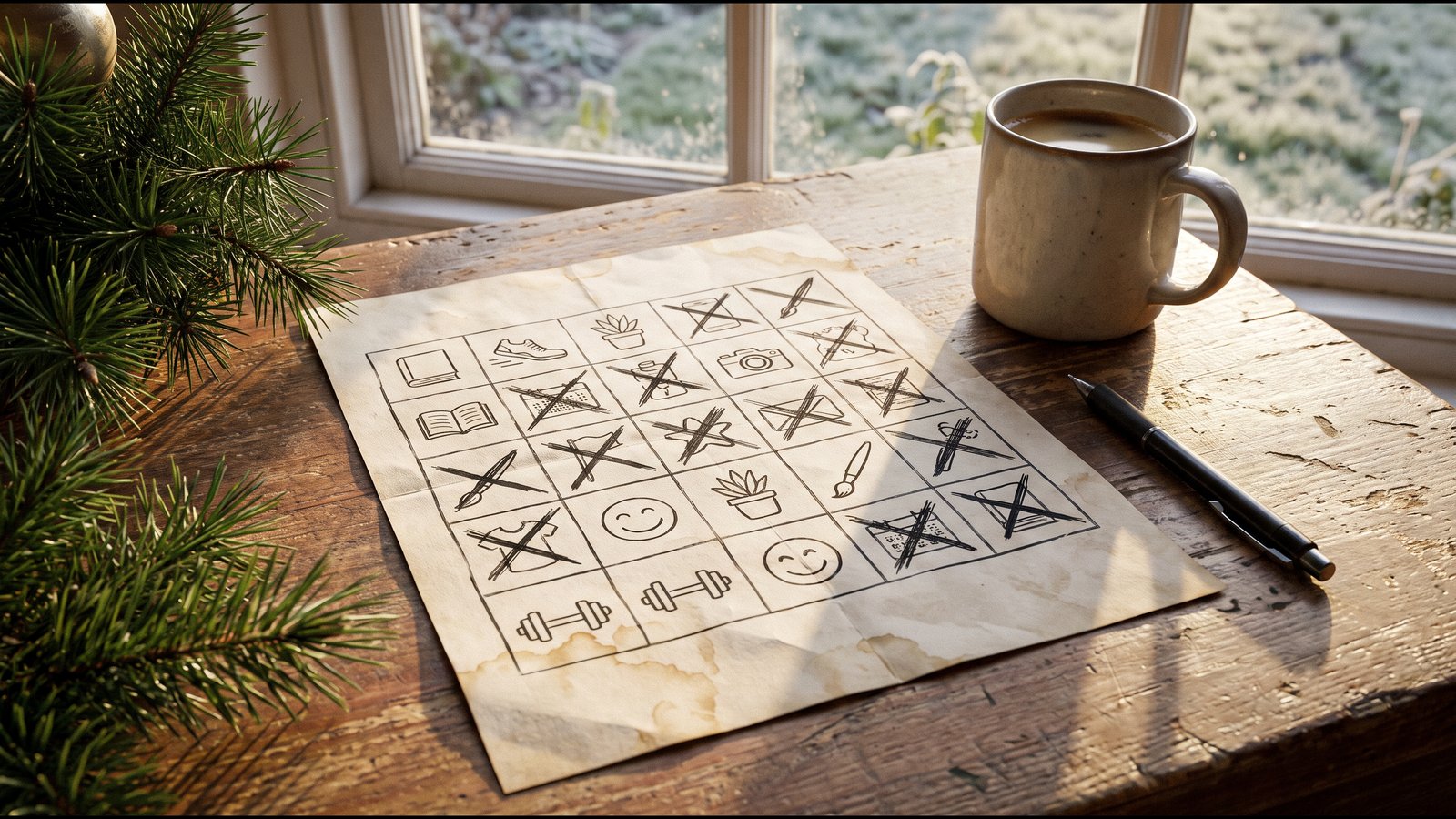
Goal bingo, resolution bingo, and vision-board bingo are one grid used three ways: words for goals, words for resolutions, or pictures. A common card has 25 spaces, with one of those a free space, so you write up to 24 goals, as the Oh My Dollar challenge describes a standard card. Cross a square when the thing happens. A row, a column, or a diagonal is a line. A full card is the long game.
Words, resolutions, or pictures
Write words or short sentences, or glue pictures, magazine cutouts, or photos, or mix images and text. That is how a vision-board bingo card differs from a word card: the square can hold a picture of the thing, not only the name of it. Resolution bingo uses the same grid and fills it with resolutions you mean to keep. Goal bingo is the wider name: any aim, habit, or small win.
The Learning Network page asks you to write 24 smaller activities if you include a free space. Its instructions focus on written activities in the squares. Images or drawings, on that page, are an optional decoration around the edges. The downloadable card itself was not opened, so this page does not compare that file's squares. Use a word card when you want small actions you can cross off. Use the vision-board version when a picture in the square will remind you faster than a sentence.
The bingo card generator on the third result offers a 5x5 grid and a free-space option, and has no worked example of a filled year board. It randomizes words you type. January-to-December play is a step you add on the printed card.
Rule a 5x5 grid
On paper, draw five rows of five squares, large enough for two or three words or a small sketch. Mark the centre free. If you would rather start from a generator, pick the 5x5 option and turn the free space on, then print and write over the sample words. Keep one card per person. A family can share the idea and still keep separate cards, so a child's small wins are not scored against an adult's.
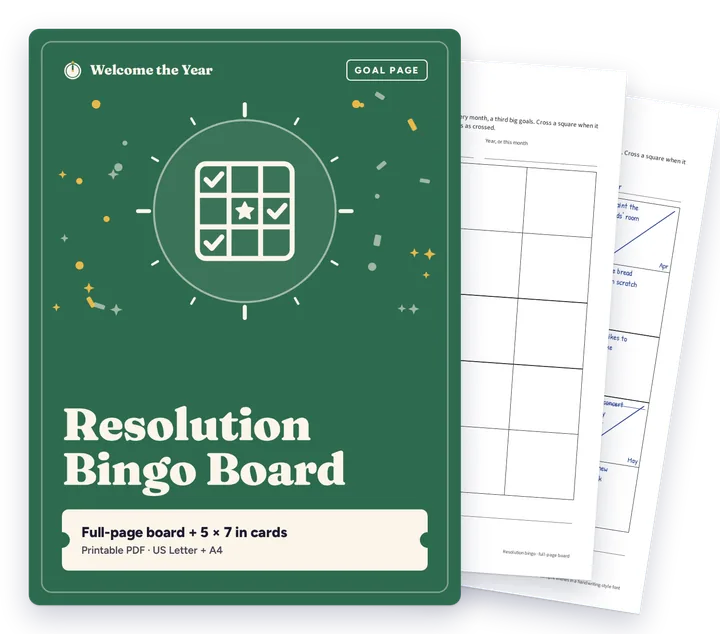
When you want the grid already ruled, the Resolution Bingo Board is a print-only PDF: a full-page 5 × 5 goal bingo board with a free centre, a name and year or month line, and treat lines for a row and a full card. It also includes 5 × 7 in bingo cards, two per sheet, with dashed cut lines, a guide with an idea list and a filled worked example, and a cover page. The download is PDF files in one ZIP, in US Letter and A4 editions. It is for writing 24 goals and small wins for the year, or for one month. It is undated: you write the year or month. The Resolution Bingo Board is $4.00.
Mix big goals with small wins
Put a few outcomes you care about on the card, and fill the rest with actions you can finish in a week. The Oh My Dollar notes say goals need not all be huge: a small win can sit beside a large one. A row that is only "run a marathon" and "change careers" will sit blank until December. A row with one large aim and three small actions can finish in a month, which is the point of playing through the year rather than waiting for New Year's Eve next time.
If a bigger aim is on the card, add an if-then line in the margin. A review of planning research describes an implementation intention in if-then form: if I encounter situation Y, then I will initiate action Z, on the National Library of Medicine page. That line is the first step. The square itself only names the aim.
Ideas to sort, then cut to what fits:
- Health: a walk after dinner, a bedtime you keep, a vegetable at lunch.
- Money: a small cash note set aside, one bill you understand, a weekly look at the balance.
- People: a call, a meal you host, a thank-you note.
- Home: one drawer cleared, one repair, one plant.
- Skill: ten minutes of practice, one page read, one song learned.
More resolution wording, grouped by area, is in the resolution list for the new year. A single aim that needs steps and check-ins belongs on a plan, which how to set goals for the new year covers. A daily habit that needs a month of ticks belongs on a tracker, covered in how to make a habit tracker.
Cross squares through the year
Hang the card where you will see it. Cross a square only after the thing has happened. When a row, column, or diagonal is complete, mark the line and choose a small treat you named in advance. If something outside your control makes a square impossible, change it, which is the rule the Oh My Dollar challenge gives. For a monthly game, print a fresh card and write smaller aims. A year card and a month card can live side by side.
A sample card (illustrative)
This card is illustrative. The squares are examples, not a survey and not a prescription.
| Walk after dinner | Call a friend | Read a chapter | Host a meal | Thank-you note |
| Save a cash note | Cook a new soup | Plant herbs | Visit a museum | Fix a wobbly chair |
| Learn a chorus | Clear one drawer | Free centre | Bedtime kept | One bill understood |
| Vegetable at lunch | Practice ten minutes | Write a page | Photo of a trip | Repair a hem |
| Ask for feedback | Library visit | Stretch on the floor | Meal with family | Lights out on time |
The free centre is the middle square, row 3 and column 3. The top row is a mix: a walk, a call, a chapter, a meal you host, and a note. The large aims (a trip, a skill) sit beside actions that can happen this month.
When a square is only a prompt
A crossed square shows that something happened. It does not write the next action for you. If the square says "save", the margin still needs the if-then line, or the square will stay a wish. That is the limit of a bingo card: it makes the year visible, and the first step still has to be written by hand.
Questions and answers
What should I put on my bingo card?
A mix of big goals and small wins, in words or pictures. Leave the centre free if you want a standard free space.
What are some good goals for a 2026 bingo board?
Use the same mix any year: a few outcomes you care about, and many small actions you can finish in a week.
What goes on a bingo card?
One goal, habit, or picture per square, plus a free centre if you are playing a 25-space card.
Can you give me an example of a bingo card?
A sample card is drawn below: free centre, a few big goals, and small wins such as a walk, a call, and a thank-you note.
What should I put on my New Year's bingo card?
Resolutions you will actually cross off: health, money, people, and home, written small enough to finish.
How to do a year bingo card?
Fill the card in January, keep it where you see it, and cross a square when the thing happens. Swap a square if life makes it impossible.
What do you put on a bingo card?
Words, short phrases, or pictures. A vision-board card can mix both.
How to make a bingo card template?
Draw five rows of five squares, or use a 5x5 option in a generator, and mark the centre free.
How to create a bingo template?
Rule a 5x5 grid on paper, label the centre free, and leave the other squares blank so each person writes their own goals.
What to put in a bingo card?
Up to 24 goals if one square is free. Mix sizes so a row can finish before December.
How many squares do you need for a bingo board?
A common card has 25 spaces, with one of those a free space, so you write up to 24 goals.
Sources
- 2024 Bingo - A Choose-Your-Own-Goals Challenge, Oh My Dollar (2023)
- Free printable yearly bingo cards, Lovely Planner
- Make Goal-Setting Fun: Create Your 2025 Professional Bingo Card, The Learning Network
- Promoting the translation of intentions into action by implementation intentions, National Library of Medicine (2015)
- SMART Goals Bingo card generator, My Free Bingo Cards