How to set goals for the new year that turn into action
How to set goals for the new year: one goal, dated steps, a first step this week, and check-ins that put the next action back on the page. Start now.

Set one goal you want, turn it into dated steps, do the first step this week, and write the dates you will check in. That is the whole method. The five moves below are an authored synthesis for this page, not the five principles on the university page and not a measured five-step outcome. A printed sheet can hold them; a blank page can too.
Five moves from a wish to this week
Name a result you want
Mindtools warns against two early detours: choosing what you think you should do, and choosing what you should stop, instead of what you want to achieve. Pick a result you would still want on a dull Wednesday. One or two resolutions are enough. More than that splits attention, which is Mindtools' realism rule.
The University of Texas Permian Basin names five principles that match this first move: commitment, clarity, a real level of challenge, a task that fits your skill, and feedback. A fuzzy goal is still a wish.
Check the wording
A clear goal answers what will be true, by when, and why you care. UT Permian Basin spells that as specific, measurable, achievable, relevant, and time-bound. "Get healthier" waits for a behavior and a date. "Walk after dinner on the weekdays I am home, through the spring" can be started.
Mindtools adds a reality check: if last year's version failed, ask what changed before you copy it. Aim at a challenge you have a real chance to finish. Write it down and put it where you will see it. A written line is part of the plan, not a decoration.
Write the steps backward
Start from the date the result should be true, and walk back to this week. Each step needs four notes:
- the action
- the date it should be done
- the obstacle you can already name, and the help you will ask for
- the habit you will mark so the step shows up on ordinary days
Mindtools calls this making a plan: milestones between here and the result, and a next action for each. UT Permian Basin treats feedback as part of goal setting, whether that is a journal or a person who hears the update. Leave room to change a step. Mindtools' flexibility rule is that a changed route can still serve the result.
Do the first step this week
The plan is live when one action has a day in the next seven days. Put the book on the table. Send the message. Block the walk on the calendar. That first step is smaller than the goal on purpose.
The pages that lead this search describe reflection, SMART wording, and milestones. The Mindtools New Year resolutions page has no first step this week. The University of Texas Permian Basin page has no first step this week. The Her New Standard page has no first step this week. Mindtools is stronger on commitment, realism, and a written plan. UT Permian Basin is stronger on the five principles and a fully specified example. Her New Standard is built for women leaders and starts with a look back at the year, which is a useful pause if you have been reacting to other people's goals. Her New Standard also offers a free step-by-step guide on that captured page, with no email required. That guide file was left unopened, so the comparison here stays with the page text. What this page adds is the instruction to date one action before the week ends, and to write the dates you will reopen the plan.
Put check-in dates on the page
Choose two dates now: about a month out, and about three months out. On each date, write what happened, what slipped, and the next step. If the step was wrong, replace it. The check-in is allowed to change the plan. That is the point.
Mindtools says to track progress in a journal and to notice when you felt like quitting. UT Permian Basin says feedback, daily or weekly, holds the goal in view. Dates make that feedback show up when the month gets loud. For how a resolution fares across a year of those check-ins, read how to keep new year's resolutions. If a step is a daily habit, mark it between check-ins with the grid in how to make a habit tracker.
What does "action plan" mean?
An action plan is the path from the goal to this week's first move, written so a tired Tuesday can follow it. It holds the goal, the steps, a date on each step, the obstacle and the help, the habit to mark, the first step this week, and the check-in dates. A goal sentence alone is a wish. The plan is the wish plus the next action.
How do I write my action plan?
Use one sheet per goal.
- Write the result in one sentence, with the date it should be true.
- Add the reason you care, in a line you would say out loud.
- List the steps from that date back to this week. Each step gets a by-when, an obstacle, the help, and the habit to mark.
- Circle the first step and give it a day this week.
- Write two check-in dates. Leave a line under each for the next step you will add that day.
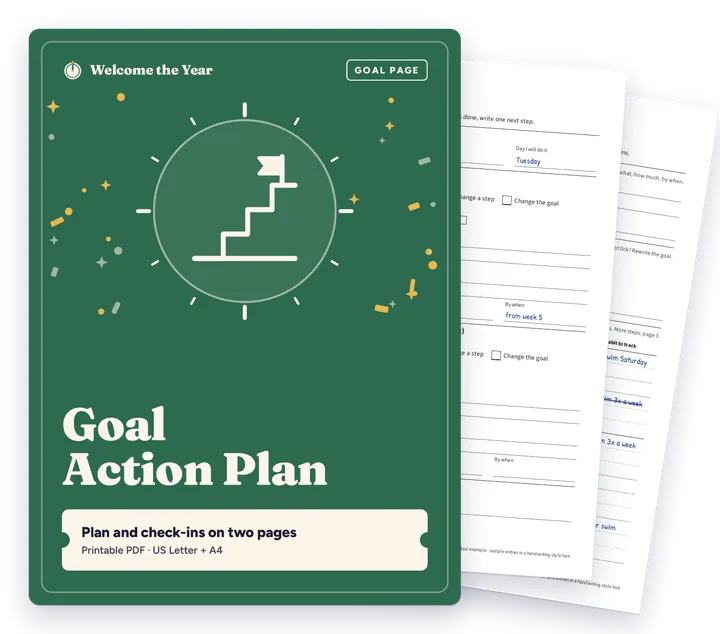
If you want those boxes already ruled, the Goal Action Plan turns one New Year goal into steps, a first step this week, and two check-ins that feed the next step back into the plan. It includes page 1 with the goal, a quality check, and a 5-row step table (step, by when, obstacle and help, habit to track); page 2 with the first step this week, 1-month and 3-month check-ins, and a "when the goal is done" box; and an optional page 3 with rows 6 to 10 and an extra check-in. It also includes a guide with a filled worked example of both sheet pages, including a late check-in that changes a step, and a cover page. It is print-only and undated: you write your own dates. It keeps one goal per sheet, with up to nine planned steps plus one added at a check-in. The download is PDF files in one ZIP, with a US Letter edition and an A4 edition. The Goal Action Plan is $3.00.
What is a good action plan example?
Goal: finish a short stack of books by next New Year, because evening scrolling has been eating the hour you wanted for reading.
- Step 1: Choose the first book by Friday and put it on the table tonight. Obstacle: you will forget after dinner. Help: the book stays on the table, and a friend hears whether you opened it on Sunday. Habit to mark: opened the book.
- Step 2: Read before breakfast on weekdays. Obstacle: late meetings push breakfast into the commute. Help: the book goes in the bag the night before.
- First step this week: put the book on the table tonight.
- Check-in: the last Sunday of the first month, and the last Sunday of the third month. If the weekday reading slipped, the check-in writes a smaller step, such as four pages with coffee, and that step replaces the old one.
The names and days in that example are a pattern, not a result from a study.
What are some good new year goals?
The lists in this section are examples you can borrow, not a ranking from a survey. A good new year goal is one you want, small enough to start this week, and specific enough to know when it happened.
What are 10 good goals?
What are 10 examples of personal goals?
What are some good goals I can set for a year?
What are some good 1 year goals?
These ten are one-year goals and personal goals at the same time. Each can be finished or seen by next New Year:
- walk after dinner on the weekdays you are home
- read a short book each month
- move a set amount to savings each payday
- cook dinner at home on weeknights
- talk with one family member each week
- keep a steady bedtime
- finish one course or a certificate you already care about
- make one extra debt payment on a set day each month
- practice an instrument or a language on three days a week
- write a page a week toward a project of your own
What are 5 good goals?
If five is the right count for you, start with these:
- a weekday walk after dinner
- a short book each month
- a payday transfer to savings
- a steady bedtime
- one conversation with family each week
What are some good daily goals I can set?
Daily goals are the marks that keep a yearly goal alive between check-ins:
- write tomorrow's three priorities
- a short tidy of one surface
- a glass of water with lunch
- one message you mean
- lights out at your set time
- a short walk
- pack tomorrow's bag
- log one purchase
Pick one daily goal per yearly goal. A long daily list is how the yearly goal gets lost. The honest limit of this method: a written plan does not remove the obstacle. The check-in is where you change the step, and only if you open the page on the date you wrote.
Questions and answers
What are the 5 steps of setting goals?
Name one result you want, check that it is specific and dated, write the steps with obstacles and help, do the first step this week, and put check-in dates on the page.
How do I write my action plan?
Write the goal, then each step with a date, the obstacle, the help, and the habit you will mark. Add the first step this week and two check-in dates.
What does "action plan" mean?
An action plan is the written path from a goal to this week's first move: steps, dates, obstacles, help, and the dates you will look again.
What is a good action plan example?
A reading goal with a book on the table tonight, weekday reading, a late-meeting obstacle, and check-ins at the end of the first month and the third month.
Sources
- New Year Resolutions, Mindtools (2024)
- New Year's Resolutions: Strategies for Successful Goal Setting, The University of Texas Permian Basin
- Effective Goal Setting for the New Year, Her New Standard