How to make a habit tracker you will actually use
How to make a habit tracker on paper: rule a monthly grid, pick a few habits worth marking, add a weekly strip, and review what to carry next month.
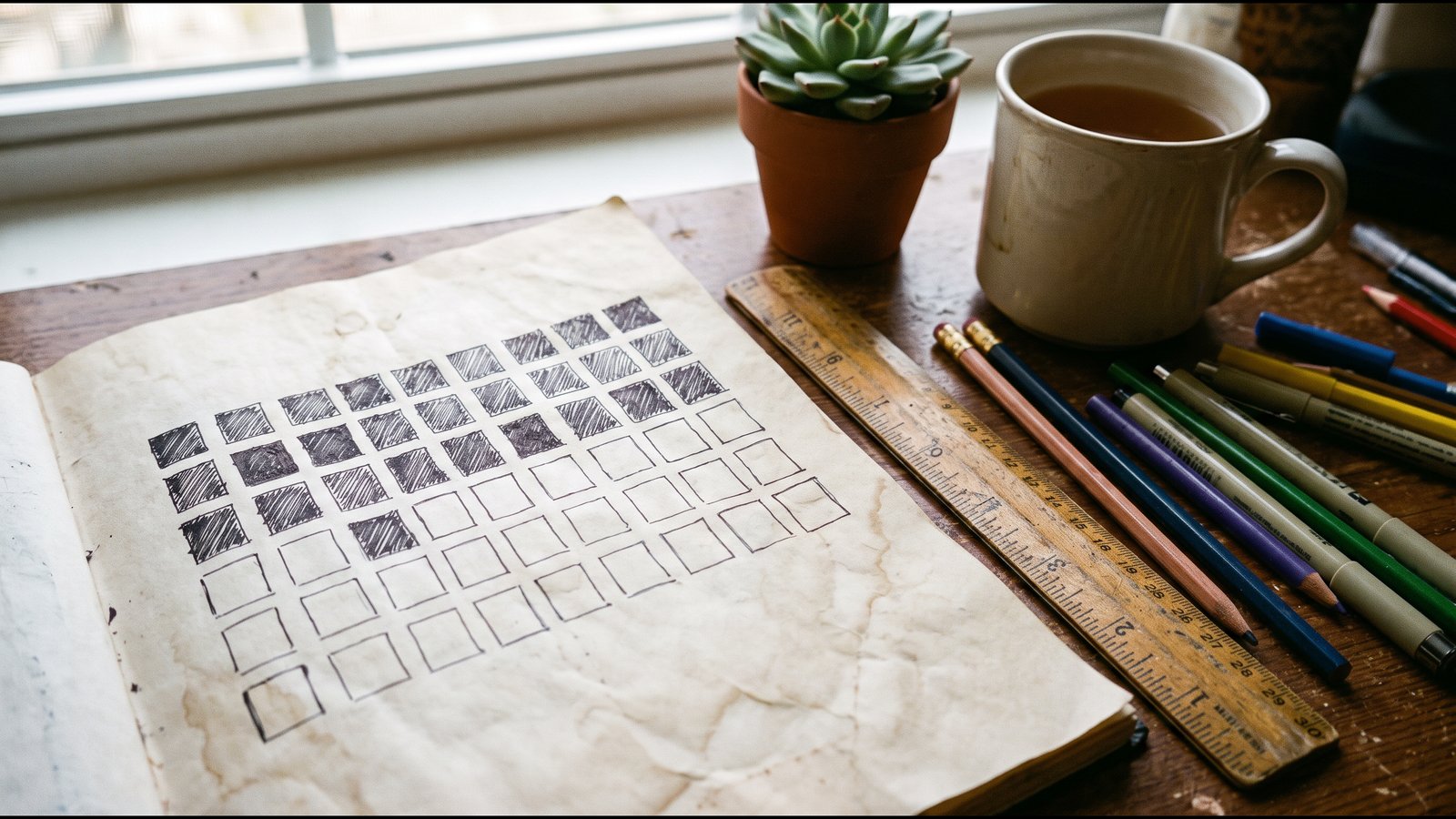
To make a habit tracker you will keep using, rule a monthly grid for a few small habits, mark the box the day you do the habit, and close the month by choosing keep, change, swap, or drop. A tracker you finish is a short list, a box you can reach, and a review that sets up next month. The steps below are the whole method. A printed sheet is optional.
Draw the month on one sheet
Start with the page, then choose the habits. A blank grid is easier to finish than a long wish list.
- Pick habits you can still do on a hard day. James Clear's habit tracker guide says it is better to track one habit consistently than to track ten now and then, and he keeps his own page to three or four. Everyday.app recommends fewer than five, often three to five, with a done-or-missed mark.
- Rule one row per habit and one box for each day of the month. Leave the habit name in a wide first column so you can read it.
- Draw a light line between weeks. A skipped week should show up as a band you can see at a glance.
- Add a tally box at the end of each row, and a review line under the grid: keep, change, swap, or drop, plus the habit name you will copy onto next month.
- Mark the box the same day you do the habit. Clear treats the finished habit as the cue to make the mark.
- On the last day of the month, fill the review line and copy the keepers onto a fresh sheet.
Shade, an X, or a dot all work. The mark only has to be obvious at arm's length. If you want a weekly view as well, add the strip in the next section rather than squeezing weekly jobs into the daily rows.
James Clear notes the figures people repeat for how long a habit takes, 21 days, 30 days, or 100 days, and points to one study whose average was 66 days, with a wide range because harder habits took longer. Use the grid to see your own month.
James Clear also writes that people who track progress on goals such as losing weight, quitting smoking, and lowering blood pressure are more likely to improve, and that one study of more than sixteen hundred people found a daily food log went with twice the weight loss. A box on a sheet is a plain version of that log. The mark is a record. The habit is still yours to do.
Ten daily habits worth a box
The ten items below are an authored starter set, not a ranking and not a study result. A list of 10 daily habits is also how Ramsey Solutions titles its own page. The set here is not that list. James Clear starts people with habits that take about two minutes, so a rough day can still get a mark. A useful daily starter set, in that spirit:
- journal one sentence
- read one page
- sit still for one minute
- do one push-up
- stretch for one minute
- write one thing you are grateful for
- make the bed
- floss
- take a walk outside
- write the day's priorities
If one of those already happens on its own, leave it off the sheet and track the one you forget. If the daily mark is serving a New Year goal, set that goal as steps first in how to set goals for the new year, then track only the habit the step names.
What are 100 things I can track in my planner?
The hundred marks below are a menu for a planner, grouped so you can steal a few. They are ideas you can borrow. Track a short list. The rest can wait until a review says a row is ready to swap.
Movement
- a short walk after a meal
- stretch before you sit down to work
- a few squats while the kettle boils
- take the stairs
- a mobility break after long sitting
- dance to one song
- a bike ride or a longer walk
- play outside with a child or a pet
- stand during each desk hour
- a short strength session
- park farther from the door
- walk during a phone call
Food and drink
- a glass of water with each meal
- a piece of fruit
- vegetables at dinner
- one meal cooked at home
- a packed lunch
- leave soda off the afternoon
- eat breakfast
- serve the snack in a bowl
- sit down to eat
- pause when you feel satisfied
- tea in place of a second coffee
- plan tomorrow's dinner
Sleep and mornings
- a steady bedtime
- a steady wake time
- screens off before bed
- dim the bedroom lights
- a wind-down routine
- charge the phone outside the bedroom
- a short afternoon rest
- sunlight soon after waking
Home
- make the bed
- dishes put away
- a short tidy of one surface
- take out the trash
- start a load of laundry
- water the plants
- wipe the kitchen counter
- a short reset of the entryway
- set up tomorrow's coffee
- put clothes away
- open a window for fresh air
- deep-clean one room
Money
- log one purchase
- move a little money to savings
- check the bank balance
- pack lunch instead of buying it
- a spend-free evening
- review the week's spending
- pay a bill on the day it arrives
- list one expense you can shrink
Work and learning
- one focused work block
- the day's three priorities written down
- mute notifications for a work block
- read a few pages
- one sentence in a journal
- a short instrument practice
- a short language practice
- clear the inbox to a stopping point
- one outreach message
- a thank-you note
- review tomorrow's calendar
- close the laptop at a set time
People
- tell someone you love them
- a message to a friend
- call a parent or a sibling
- a device-free meal together
- a walk with a friend
- help with one household job
- a sincere note to a coworker
- listen all the way through
- play a game with a child
- thank someone who helped you
Attention and mood
- one thing you are grateful for
- a short meditation
- three slow breaths
- a mood word in the margin
- a worry written down and closed
- a doodle or a creative mark
- time outside with the phone in a pocket
- a news break after lunch
- one page of a book before screens
- name the feeling before you react
- a compliment you mean
- sit quietly for a minute
Limits you can mark
- an alcohol-free evening
- leave the streaming app closed
- leave online shopping for another day
- a sugar-light dessert
- leave the extra caffeine
- a smoke-free day
- leave the snooze button alone
- a screen-free stretch in the evening
- leave the late-night snack
- a gossip-free conversation
- leave the second helping
- the phone in another room while you work
- a complaint-free morning
- leave an impulse purchase until tomorrow
A weekly strip for once-a-week jobs
Some jobs are weekly, and a daily row makes them look like failures. James Clear uses a tracker for weekly jobs such as laundry, watering plants, and a thank-you note, and for monthly jobs such as reviewing finances and paying bills. Give those a separate strip:
- one row per weekly job
- a box for each day of the week, so you can mark the day it actually happened
- a note line for "moved to Thursday" or "did half"
- a monthly row under that for the money check and the bill you mean to pay
Everyday.app likes a weekly look-back because a weekend slip is easier to see across several days than in a single guilty box. Use the strip for that look-back. Keep the daily grid for the habits you want most days.
The month-end review
The review is four words and one decision per row: keep, change, swap, or drop. Write the decision on the sheet, then copy only the keepers and the swaps onto next month's rows. That is what makes the tracker a system instead of a stack of finished grids.
Ask three questions for each row:
- Did this habit still matter this month?
- Was the action small enough to mark on a bad week?
- What will the row be called next month?
A late start and a skipped week belong in the tally, as information. Return the next day. James Clear treats one missed day as an accident and the following day as the restart.
The captured Notion marketplace page was not fully readable. The saved listing stops before a template description, so this guide compares only opened artifacts. Everyday.app is an ideas guide for an app, and it is direct about keeping the list short. The yearly planner PDF offered on the 101 Planners habit tracker page includes a monthly reflection on the month pages: whether you achieved the month's goals, what went well, what you learned, what you could have done better, and a line for what you will do next month. This guide adds a blank sheet you can rule: week bands, a tally, and a decision on each habit row (keep, change, swap, or drop) that you copy onto next month's rows. The planners site is stronger if you want a decorated printable already made. Notion is an app system if you already live there, and the template body stayed unread in this capture.
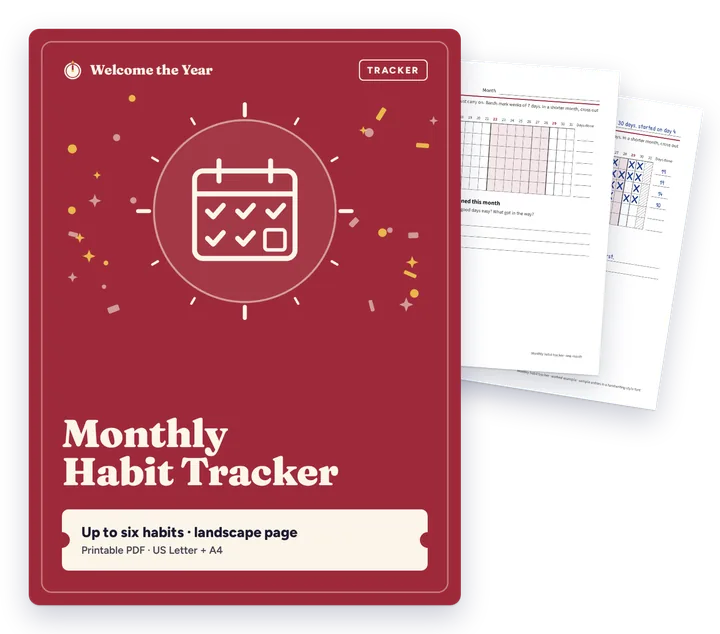
If you would rather print that sheet than rule it, the Monthly Habit Tracker tracks up to six daily habits for a month, counts the days done, and sets up next month from a short review. It includes a landscape monthly habit tracker with up to six habits across days 1 to 31, week bands, a days-done column, an end-of-month review (keep, change, swap or drop) whose lines match next month's rows, and a notes box, plus a worked example of a filled 30-day month with a late start and a skipped week, a guide, and a cover page. It is print-only, and it is undated: you write the month and cross out days a shorter month does not have. It holds up to six habits per sheet. The download is PDF files in one ZIP, with US Letter and A4 editions. The Monthly Habit Tracker is $1.99.
Keeping the marks is a different job from choosing the goal. If the row is a New Year's resolution you want to still be doing in March, the check-in routine in how to keep new year's resolutions sits beside this grid.
Questions and answers
How do I create my own habit tracker?
Rule one row per habit and one box per day, mark the box the day you do it, and at month's end choose keep, change, swap, or drop.
How can I create my own habit Tracker?
Use a pen and one sheet: a few habits, a box for each day, week lines, a tally, and a review line that names next month's habits.
What are good habits for a habit Tracker?
Small daily actions you can still do on a hard day, plus a few weekly jobs. The lists below are a menu.
What are some ideas for a weekly habit tracker?
Give each weekly job a row and a box for each day of the week. Laundry, plants, a thank-you note, and a money check are common starters.
What are 10 good daily habits?
An authored starter set, not a ranking: one journal sentence, one page read, a minute of stillness, one push-up, a short stretch, a gratitude line, the bed made, floss, a walk, and the day's priorities written down.
Sources
- The Ultimate Habit Tracker Guide: Why and How to Track Your Habits, James Clear
- Habit Tracker Ideas: What to Track (and How to Stick With It), Everyday (2026)
- FREE Habit Tracker Template, 101 Planners (2025)
- Ultimate Habit Tracker Template by The Organized Notebook, Notion
- 10 Daily Habits That Will Set You Up for Success, Ramsey Solutions