How to keep new year's resolutions past January
How to keep new year's resolutions past January, using study figures on how long they last, which goals people name, and a dated paper check-in.

To keep a New Year's resolution past January, use this routine before you look up how long other people lasted. Write one specific action you can repeat on an ordinary day. Name the support you need, and ask that person for a specific kind of help. Track the action where you will see it. Put a review date on the calendar before the month ends. After a slip, do the next planned action instead of dropping the resolution. How long resolutions usually last, and which themes people name, come after this routine. A paper check-in you can copy is further down.
Name the behavior you will repeat
Approach the change you want, in a form you can do on a Tuesday. PLOS ONE found that 64.5% of participants wrote the primary resolution as an approach-oriented goal, and that 58.9% of that group counted themselves successful, compared with 47.1% of the avoidance group.
Colorado State University asks you to shrink the goal until the time frame is believable: a basic conversation by the end of three months, rather than full fluency in that same span, and a reward after an early stretch such as two weeks of the new eating pattern. Choose a small number of resolutions so attention stays on the one that matters. Write the goal where you will see it, and tell one person.
Kaiser Permanente Georgia adds the reason in your own words. "I should quit" is weaker, on that page, than a reason you can picture, such as being around for a grandchild. Then make the action specific enough to stock the cupboard for it: oatmeal in the morning, already in the house, instead of a general plan to eat better.
"Walk after dinner" and "stop being lazy" are illustrative examples of an approach goal and an avoidance goal. They are examples on this page, not phrases the study measured.
Slip-ups are part of the record. Colorado State University says one misstep is a moment to regroup, and Kaiser Permanente Georgia says an extra piece of cake is a poor reason to abandon the resolution. Say what you would tell a friend, then do the next planned action. If the resolution needs steps and dates before it can be a habit, write those in how to set goals for the new year.
How long people usually keep them
People who make a resolution often last the first week and thin out after that. The two pictures in this section use different samples. Read them as a range, then keep the review date you wrote above.
The year-long figure comes from people who signed up to be studied. Oscarsson and colleagues enrolled 1,066 participants in late 2016 and asked them to rate success on a scale from full abandonment to fully sticking with the resolution. At the December follow-up, 55% of responders considered themselves successful. That is self-report. The authors note that a vague resolution is easier to call a success than a precise one, and that objective measures of habits such as physical activity can disagree with what people say. Treat 55% as what this volunteer group reported, and keep a counted goal if you want a stricter score than a vague one.
The week-to-two-year drop is the follow-up the paper summarizes from Norcross and Vangarelli. PLOS ONE states that 77% of those 200 participants had maintained their resolutions after one week, 55% after one month, 43% after three months, 40% after six months, and 19% at two years. A subsequent study summarized in the PLOS ONE paper found resolvers at six months reporting success at 46% compared to 4% among people who meant to change a problem later.
Support mattered, and a heavier packet of instruction was a weaker bet than a lighter one. In the Stockholm study, the group given some support (a named helper, monthly follow-ups, and one email on hurdles) had a higher mean success score, 62.3, than the group given only general information, 55.9. A named person and a monthly look-back were the pieces that traveled with the higher score. Kaiser Permanente Georgia makes the same practical point: tell people who can help, and ask for a specific kind of help.
Kaiser Permanente Georgia cites Statistics Brain for a widely repeated pair of figures, 45 percent making specific resolutions and 8 percent following through, and the page stops at that citation. Prefer the studies above when you want a sample and a follow-up date.
What are the 5 most common new year's resolutions?
PLOS ONE categorized 1,062 primary resolutions and published shares for five: physical health at 33%, weight loss at 20%, eating habits at 13%, personal growth at 9%, and mental health or sleep at 5%. The other 20% covered work, studies, tobacco habits, and similar topics as one group. Earlier studies the paper summarizes also return to physical health, interpersonal relationships, personal growth, and academic results.
- physical health
- weight loss
- eating habits
- personal growth
- mental health or sleep
What are the 10 most common new year's resolutions?
The study ranks five categories. It does not publish a ranked top ten. The five shares above are the ranked list. Other themes the opened sources name are unranked. They are not a researched top ten.
- Work, studies, and tobacco habits sit in the study's remaining group, reported together rather than as separate ranks.
- Relationships are a recurring topic in the earlier studies the paper summarizes.
- Getting organized, or learning a hobby, is among the resolutions Colorado State University names, along with exercise and weight loss.
Kaiser Permanente Georgia calls weight loss the resolution Americans name first, and then shows why the vague version stalls: the page suggests a specific behavior, such as a walk of 20 minutes on three set days, or cutting a sweet portion, instead of a general promise to lose weight. If you want a longer menu of resolution wording, see new year resolution ideas. The check-in you can copy is the next section.
A dated check-in you can copy
The research points to a monthly look-back. The pages above describe that idea and stop short of a card you can fill. The Kaiser Permanente Georgia page has no check-in card. The Colorado State University page has no check-in card. The PLOS ONE paper has no check-in card a reader can copy. Here is one, on a single sheet:
- Date of this check-in, and the date of the next one
- The resolution as one behavior
- What happened: done, partial, or missed, in a few words
- One obstacle, and the help you will ask for
- One change for the next stretch
- The habit you will mark until the next date
Put the next date on a calendar the day you write the card. If the behavior is daily, mark it on a grid between check-ins; the layout is in how to make a habit tracker.
A chart for units you can count
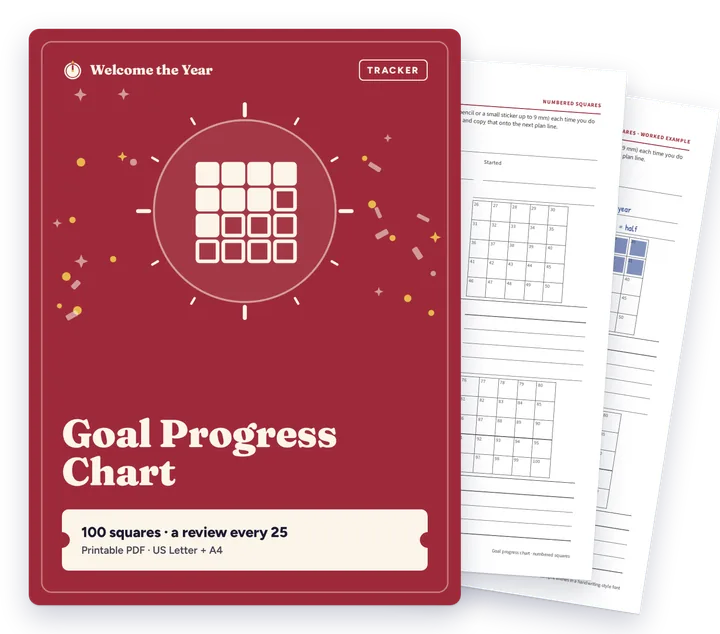
Some resolutions are a count: pages read, walks taken, dollars moved to savings. A square per unit shows that count across the month. The Goal Progress Chart fills one square for every unit of progress toward one goal, with a reward and a short review at every 25 squares. It includes a 100-square progress chart for one goal in four blocks of 25, each with a plan line and a milestone box (reward, what slipped, what the next 25 need), plus the same chart with blank squares for stickers or your own numbering, a guide with a filled worked example, and a cover page. It is print-only and undated, so you write your own start. It keeps one goal per chart, and past 100 squares continue on a second chart. The download is PDF files in one ZIP, for US Letter and for A4. The Goal Progress Chart is $1.99.
The honest limit of these figures: they describe people who answered a study or a follow-up, and a vague goal is easier to score as a success than a counted one. Your check-in date is the number that belongs to you.
Questions and answers
How long do people usually keep new year's resolutions?
A Stockholm University study in PLOS ONE found 55% of responders still successful at one year, and reports a follow-up of 200 resolvers with 77% still going after one week, 55% after one month, 40% after six months, and 19% at two years.
What are the 5 most common new year's resolutions?
In that study the top five were physical health, weight loss, eating habits, personal growth, and mental health or sleep.
What are the 10 most common new year's resolutions?
In that study only five categories are ranked: physical health, weight loss, eating habits, personal growth, and mental health or sleep. Work, studies, tobacco, and relationships are named and unranked.
What are the 10 most common New Year's resolutions?
Only five are ranked in that sample. Other themes the opened pages name are unranked, not a published top ten.
Sources
- A large-scale experiment on New Year's resolutions: Approach-oriented goals are more successful than avoidance-oriented goals, PLOS ONE (2020)
- 7 Tricks for Keeping Your New Year's Resolutions, Kaiser Permanente Georgia
- Tips for keeping those New Year's resolutions, Colorado State University (2025)