How to Host a Murder Mystery Party from Casting to the Reveal
Match a murder-mystery kit to the confirmed guest count, cast every required role, run clues through a reveal, and keep a jewel theft as a separate party.
Host a murder mystery party by counting the people who confirmed, choosing a kit whose required roles fit that count, sending each person a character packet early, releasing clues in rounds, and revealing the culprit only after the accusations. Playing With Murder groups its kits as 10 or fewer guests, 11-29 guests, and 30+ guests, and it asks for a minimum of two weeks to prepare. One host who invited 18 people bought a package that accommodates up to 20 people, then gave the room about 30 minutes of snacks before the first act (Short & Sweet).
The reliable way to host the night is the same sequence: confirm the headcount, choose a kit whose required roles fit, send character packets early, then run introduction, investigation, accusation, and revelation.
That headcount rule is the whole answer to "how many people." There is no single right size. A table game and a manor full of optional suspects are different kits.
Confirmed headcount before the theme
Write down everyone who said yes, including yourself if you will hold a role. Then read the kit, not the theme name. You need a certain number of confirmed participants for the party to run, and a last-minute cancellation means you may need an alternate player (Playing With Murder).
Use this order:
- Count required roles. If confirmed guests are fewer than required roles, that kit will stall. Pick a smaller kit or recruit the missing person before you send invitations.
- Count optional roles. Extra guests take optional roles. If you have more guests than required plus optional, someone will sit outside the plot.
- Name one alternate who can take a required role on the day. Call the list a week out and replace a cancellation then, while costumes and food can still change.
- Drop an optional role before you ever leave a required role empty.
Illustrative: nine friends confirm. The kit on the table needs eight roles and offers four optional roles. The eight required roles fit, and one optional role covers the ninth person. A different kit that needs twelve required roles is the wrong size for this nine. The illustration uses invented counts so the method is visible; your kit's own role list is the one that counts.
Playing With Murder also sells a short line meant to be played around a table by eight people, or up to eight teams. That is one product line. It is not the size of every murder mystery party. The same shop's wider bands, 10 or fewer, 11-29, and 30+, are a reminder to shop by headcount.
The thortful hosting guide has no guest-count method for matching required roles to confirmed guests. It is still useful on theme, packets, and the reveal. Use it for those jobs, and use the role count for the size decision.
Casting and the packets you send
A workable cast has a victim, detectives, witnesses, red herrings, and the murderer (thortful). Give the talkative guest a role with a public speech. Give the quiet guest a role whose secret is written down, so they can read it. When the printed genders and the room disagree, change a character the way one host did when the group had more men than women (Short & Sweet). Tell that person early, so the costume still fits.
Each packet should carry background, a private objective, and a secret (The Murder Mystery Co). The invitation should name the character, suggest a costume, and give enough background that the guest can prepare. Send it with the date, time, place, and theme. A riddle on the card is a nice extra; the role is the part they cannot guess on the night.
If writing motives and a fair solution feels too large, buy a kit. Pre-made kits come with characters, clues, and scripts (thortful). One host's package arrived with a host guide, scripted character sheets, question menus, invitations, costume suggestions, whodunnit slips, and audio evidence (Short & Sweet). Read the whole host book before you assign anyone. You will host better if you already know which clue lands in which round.
For the wording on the card itself, see New Year's Eve invitation wording if the party falls on that night. The role still has to be on the card, whatever the greeting says.
Arrival, rounds, and the culprit
A typical game moves through four stages (The Murder Mystery Co):
- Introduction: guests arrive and learn about the murder.
- Investigation: guests mingle, gather clues, and uncover secrets.
- Accusation: guests name who they believe is the culprit.
- Revelation: the true murderer and the motive come out.
Plan the clock backward from the reveal. Playing With Murder splits prep into a minimum of two weeks (date, place, menu, decorations, invitations), one week (supplies, attendance check, printed character sheets, clues, tokens, and voting sheets), the day before (decor and food that can wait), and the day itself (finish the room hours before arrival and set folders out). On the night, one host asked people to arrive about 30 minutes early for snacks, handed each person an envelope, and found the first questioning round took about 20-30 minutes before the next piece of evidence (Short & Sweet).
If the date is New Year's Eve, put the revelation before the countdown. A festive crime theme is one way to dress the room (thortful). The countdown should meet a room that already knows the culprit, not a room still arguing. Theme ideas for the rest of the night sit in New Year's Eve party themes.
During investigation, your job is pace. Prompt alibis, start a short round of questions, and move the plot when talk stalls (thortful). If the group is large, sit everyone in a circle for a round so nobody repeats the same alibi six times in the hallway. That was the fix when 18 people made mingling too slow (Short & Sweet).
Clues the host releases
Keep the solution with you until accusations are in. The host distributes clues at the moments that advance the investigation, through notes, a short performance, or a found object (The Murder Mystery Co). Release them in rounds so the first clue cannot solve the case alone. A practical split:
- Round one: each guest shares one public fact from the packet. You add the opening scene.
- Round two: you release one new clue, then each guest shares a second fact.
- Final round: you release the last clue, guests accuse, and only then does the culprit come out.
That round shape is how a short table mystery is built: an opening script, a clue, another pass around the table, a last clue, then theories (Playing With Murder). A longer dinner can use the same shape with a course between rounds. One game had the guilty party read a confession last, after accusations, which kept the suspense in the room (Short & Sweet).
After the name is out, spend a few minutes on missed clues and red herrings (thortful). Guests want to know which hint they walked past. That debrief is the reveal's second half, and it is where a good host book earns its keep.
Food can follow the rounds: a three-course dinner if the kit is long, or nibbles if the theme is a ball (thortful). Serve the last course after the revelation if you want the table to stay through the debrief.
Teens, children, and a thirteen-year-old
Age is a kit choice, the same way headcount is. Playing With Murder keeps Children Themes, Teen Themes, and Adult Themes as separate lists. Its teen page says the following games are appropriate for teenage audiences, and it names sex, drugs, and alcohol as material kept off those games. That is one seller's teen shelf. It is not a promise that every murder plot suits a thirteen-year-old, and it is not a children's party.
For a thirteen-year-old, read the kit's age note before you assign a murder role. If the note is adult, pick a different kit or a different kind of party. Small children and a murder plot are a poor match; use a children list the seller marks for that age, or choose another game. A puzzle night with paper clues is a different build, covered in DIY escape room at home.
A jewel theft kept apart from the murder plot
Everything above is for a murder-plot party. A theft plot is a different story, and some commercial nights are built that way on purpose. The Murder Mystery Co lists a modern-day mystery that revolves around the theft of a diamond, kept apart from its murder themes. That is their show, not a file from this shop.
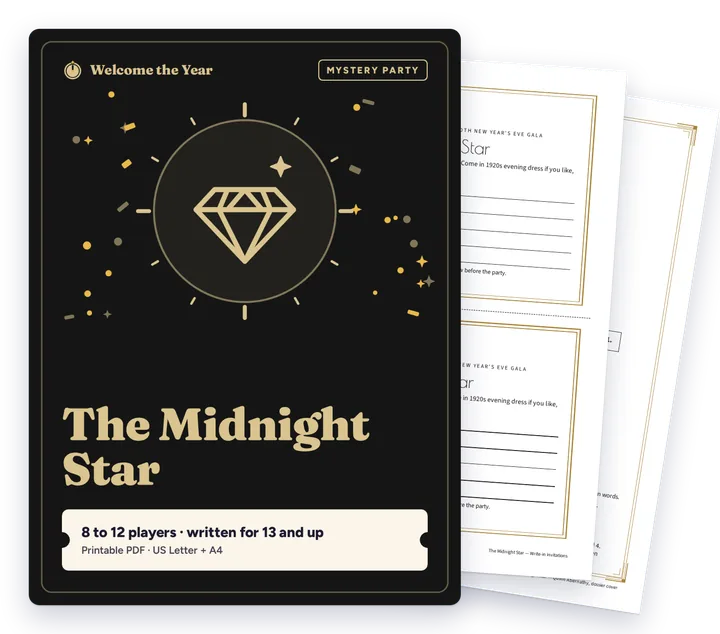
If you want a printed New Year's Eve party with a theft and a fixed cast, the Midnight Star gala mystery hosts a New Year's Eve jewel-theft mystery party for 8 to 12 teens and adults, run from the printed pages and finished before midnight. It includes a host guide with a casting aid, a no-show table, a print plan, a prep countdown and a one-page run sheet, plus 8 core roles and 4 optional roles. It also holds 12 character dossiers, 9 fold-to-hide clue sheets, accusation sheets and a sealed solution. It is written for ages 13 and up: a theft, no murder, no alcohol in the story. It is sold as printable PDFs in US Letter and A4 editions for $30.00. Small children need a different game. The murder-plot steps above are the ones to follow when the story is a killing.
This page can show you how to choose, cast, and pace a murder-plot party. The kit you buy still holds the private solution and the lines each guest must read.
Questions and answers
Can kids play murder mystery?
Only if the kit's own age note says so. Sellers keep children, teen, and adult lists apart. A murder plot is a poor fit for small children.
How many people should be at a murder mystery party?
As many as the kit's required roles need, and only as many extra people as its optional roles can absorb. Match the kit to the confirmed count.
How to do a murder mystery game party?
Pick the kit for the confirmed count, cast every required role, print the packets, release clues in rounds, and reveal the culprit after accusations.
What are some ideas for a murder mystery party?
A manor dinner, a roaring-twenties night, a masquerade, or a festive crime are theme sparks. Each one still needs a kit with roles, clues, and a solution.
How to throw a murder mystery party for teens?
Use a seller's teen list, send each teen a character packet early, and read that kit's age note before you assign a murder role.
Sources
- How to host a murder mystery party, thortful (2024)
- How Does a Murder Mystery Dinner Party Work?, The Murder Mystery Co (2024)
- Hosting a Mystery Party, Playing With Murder (2026)
- How to host a murder mystery party, Short & Sweet (2018)
- Teen Themes, Playing With Murder (2026)